LINQ and Entity Framework Core - Data Access Made Easy
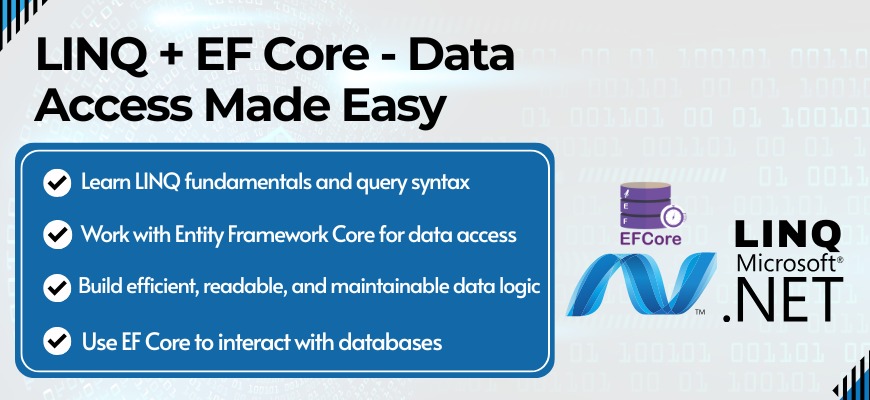
Unlock the full potential of LINQ to query and manipulate data directly within C#. Explore how to perform advanced filtering, grouping, and joins across collections and databases with elegant, concise syntax. This course helps you write cleaner, more efficient, and maintainable C# code using LINQ
Course Topics:
LINQ and Entity Framework Core.
Introduction to LINQ
Core LINQ Operators
Core LINQ operators are the building blocks of LINQ queries. They provide a set of standard methods to filter, transform, group, join, sort, and aggregate data from various sources like collections, databases, or XML. These operators make queries declarative and readable, letting you work with data in a consistent way without writing complex loops or conditionals. Essentially, they are the foundation for writing any LINQ query efficiently.
Grouping, Joining & Set Operations
Grouping, Joining, and Set operators in LINQ are used to organize, combine, and compare collections. Grouping operators like GroupBy collect elements based on a key, forming logical groups. Joining operators like Join and GroupJoin combine data from multiple sources using matching keys. Set operators like Union, Intersect, Except, and Distinct allow comparison and merging of collections similar to mathematical sets. Together, they help you categorize, relate, and manipulate data efficiently
Element, Quantifier & Aggregation Operators
Element, Quantifier, and Aggregation operators in LINQ are used to access specific elements, check conditions, and compute summary values from collections. Element operators like First, Last, and Single retrieve particular items. Quantifier operators such as Any, All, and Contains test whether elements meet certain conditions. Aggregation operators like Count, Sum, Min, Max, and Average calculate overall values from the data. Together, they let you pick, validate, and summarize data efficiently.
Introduction to Entity Framework Core
Entity Framework Core (EF Core) is a modern, lightweight, and cross-platform Object-Relational Mapper (ORM) for .NET. It allows developers to interact with databases using .NET objects instead of writing raw SQL queries. EF Core supports LINQ queries, change tracking, schema migrations, and database relationships, making data access more intuitive and maintainable. It works with multiple database providers, such as SQL Server, SQLite, PostgreSQL, and MySQL, enabling flexible and efficient database operations across different platforms.
Development Approaches
Development approaches in EF Core define how your application interacts with the database. The two main approaches are Code-First, where you define models in code and generate the database from them, and Database-First, where you start from an existing database and generate models in code. These approaches help organize data access and maintain consistency between code and database.
Data Operations
Data operations in EF Core cover the essential CRUD actions—Create, Read, Update, Delete—using .NET objects instead of raw SQL. EF Core tracks changes to entities, generates the appropriate SQL, and ensures safe, efficient database interactions. Key operations include Add, Find, Update, Remove, and SaveChanges, allowing developers to manage and persist data seamlessly.
Entity Configuration
Entity configuration in EF Core defines how entity classes map to database tables and columns. It controls settings like primary keys, relationships, constraints, and data types to ensure accurate mapping between your models and the database. You can configure entities using Data Annotations within classes or the Fluent API inside the OnModelCreating method. This helps maintain a clear and consistent data structure.
Relationships, Loading & Advanced Topics
In EF Core, relationships define how entities connect — such as one-to-one, one-to-many, and many-to-many. Loading strategies control how related data is fetched: eager loading loads it upfront, lazy loading loads it when accessed, and explicit loading loads it manually. Advanced topics include concurrency handling, transactions, raw SQL queries, and shadow properties, which help manage complex data scenarios and maintain consistency.
Design, Testing & Best Practices
In EF Core, design focuses on building clean and scalable data models that match your application’s logic. Testing ensures your data operations work as expected, often using in-memory databases or mocking frameworks for isolation. Following best practices like keeping DbContext short-lived, using AsNoTracking for read-only queries, managing migrations carefully, and optimizing queries helps improve performance, reliability, and maintainability.