Building Web APIs with ASP Dotnet Core
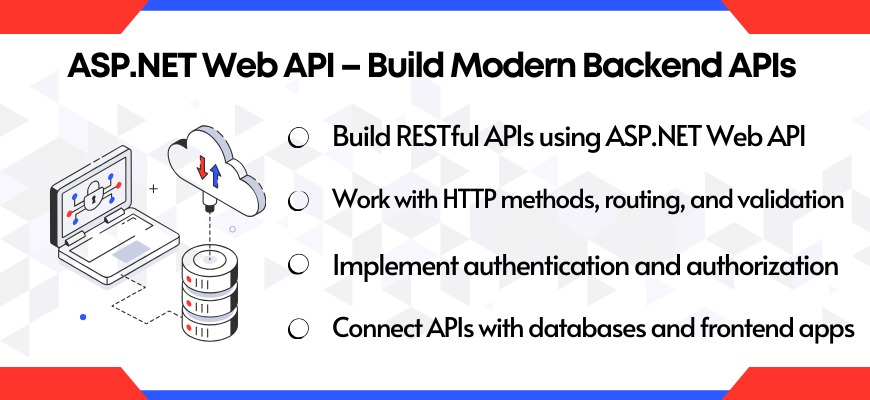
Learn how to design and develop scalable RESTful APIs using ASP.NET Core Web API. This course walks you through controllers, routing, dependency injection, authentication, and versioning. By the end, you’ll be able to build secure and efficient APIs that power modern web and mobile applications
Course Topics:
ASP DOTNET Core
Introduction to .NET Core Web API
Environment Setup and Tooling
This chapter covers the essential tools and setup required to start working with .NET Core Web API. You will learn how to install the .NET SDK, choose an IDE such as Visual Studio or VS Code, and configure supporting tools like Postman and Git. By the end of this chapter, your development environment will be ready to create, build, test, and manage Web API projects efficiently.
Creating Your First Web API Project
This chapter guides you through creating your first .NET Core Web API project step-by-step. You will learn how to use project templates, understand the initial folder structure, and run the API using the built-in development server. By the end of this chapter, you will be able to create, launch, and access a basic Web API endpoint through Swagger or a testing tool like Postman.
Understanding Project Structure and Key Files
This chapter explains the layout of a .NET Core Web API project and the purpose of its key files and folders. You will learn how components such as Program.cs, appsettings.json, Controllers, and Models work together to form the application. By the end of this chapter, you will clearly understand how the project is organized and where to make changes when building or maintaining an API.
Controllers, Actions, and Routing
This chapter explains how controllers, action methods, and routing work together to handle API requests in ASP.NET Core Web API. You will learn how to create controllers, define actions for different HTTP verbs, and configure routing patterns to map client requests to the correct endpoints. By the end of this chapter, you will be able to design and organize API endpoints effectively.
Working with Entity Framework Core
This chapter introduces Entity Framework Core and shows how it is used to interact with databases in a .NET Core Web API. You will learn how to create data models, configure a database context, and use EF Core’s features to perform CRUD operations. By the end of this chapter, you will be able to connect your API to a database and manage data effectively using EF Core.
CRUD Operations
This chapter covers how to apply database migrations and implement CRUD operations using Entity Framework Core in a .NET Core Web API. You will learn how to generate and update database schemas, and create endpoints for creating, reading, updating, and deleting data. By the end of this chapter, you will be able to manage database changes and build fully functional data-driven APIs.
Dependency Injection in Web API
This chapter explains the concept of Dependency Injection (DI) and how it is used in ASP.NET Core Web API to manage service lifetimes and dependencies. You will learn how to register services in the container, inject them into controllers, and apply best practices to improve code organization and maintainability. By the end of this chapter, you will be able to structure your application in a clean and modular way using DI.
Middleware and Request Pipeline
This chapter explains how the request pipeline works in ASP.NET Core Web API and the role of middleware components in processing HTTP requests. You will learn how to add, configure, and order middleware such as authentication, logging, and exception handling. By the end of this chapter, you will understand how requests flow through the application and how to customize the pipeline to fit project needs.
Configuration, AppSettings, Logging, and Error Handling
This chapter covers how to manage configuration settings using appsettings.json, environment variables, and configuration providers in ASP.NET Core Web API. You will also learn how to implement logging to track application behavior and set up error handling to manage exceptions gracefully. By the end of this chapter, you will be able to configure your API securely, monitor its performance, and handle errors in a clean and consistent way.
File Upload and Download in Web API
This chapter explains how to handle file upload and download operations in ASP.NET Core Web API. You will learn how to accept files from clients, validate and store them securely, and provide endpoints for users to download stored files. By the end of this chapter, you will be able to implement safe and efficient file handling features within your API.
Authentication & Authorization (JWT, Role/Policy-Based)
This chapter focuses on securing your ASP.NET Core Web API using authentication and authorization techniques. You will learn how to implement JWT-based authentication, assign user roles, and apply policy-based authorization to control access to API endpoints. By the end of this chapter, you will be able to protect sensitive resources and ensure only authorized users can perform specific actions within your application.
API Versioning, Caching & Performance Optimization
This chapter explains how to manage multiple API versions, improve response speed, and optimize overall performance in ASP.NET Core Web API. You will learn how to implement API versioning strategies, apply caching to reduce repeated processing, and use performance optimization techniques such as response compression and efficient data handling. By the end of this chapter, your API will be more scalable, faster, and ready for real-world workloads.
API Documentation, Testing, & Deployment
This chapter covers how to properly document, test, and deploy your ASP.NET Core Web API for real-world use. You will learn how to generate clear and interactive documentation using Swagger, write unit and integration tests to ensure reliability, and deploy your API to environments such as IIS, cloud services, or Docker containers. By the end of this chapter, you will be able to deliver a fully tested, well-documented, and production-ready API.