Verified Practical Experience and certification already tell a company a great deal about a candidate. But for many hiring teams, there's still real value in one more layer of assurance — a live interview test built around the exact skill they're hiring for. What's worth understanding is how little friction Become A Skiller adds to get that layer in place, and how much of the evaluation work AI quietly takes on.
Why a Reusable Interview Test Changes the Workflow
When a company wants to evaluate a selected candidate further, it can build an interview test template using questions pulled directly from the purchased course. The value here isn't just convenience — it's consistency. Instead of writing new questions for every candidate, the company chooses relevant questions once, built around the knowledge, understanding, and problem-solving ability it actually wants to measure.
That template is saved, not spent. The next time the company needs to interview a candidate for the same skill, the same structured assessment is ready to use again — meaning every candidate for a given role is measured against the same bar.
What Goes Into Scheduling an Assessment
Scheduling an interview is where the template actually gets put to use. The company selects a candidate, picks a date from the calendar, and defines the event around it:
- Event name & description
- Event location, including Online
- Start and end date & time, with time zone
- The interview test template to use
Because the template is attached at this same step, there's no separate process of assembling a new assessment for each interview. The scheduling step and the assessment itself are handled together.
Where AI Actually Fits Into the Evaluation
Once a candidate completes the assessment, their responses are captured automatically — and this is where Become A Skiller's AI-driven validation does its most useful work. Optional-type questions are checked automatically against configured correct answers, which is straightforward. The harder problem — descriptive, open-ended responses that are usually the slowest and most subjective to grade — are evaluated using the platform's AI-driven validation capabilities, which assess each answer against the relevant evaluation criteria.
What this actually changes for a hiring team is scale without a drop in depth. Evaluating descriptive answers for dozens or hundreds of candidates by hand simply isn't realistic for most teams — AI validation makes that level of evaluation practical, without reducing it to a simple keyword match. Where applicable, this same validation and feedback also feeds into the broader competency verification process that helps establish a candidate's Verified Practical Experience.
How the Platform Keeps Every Candidate Accounted For
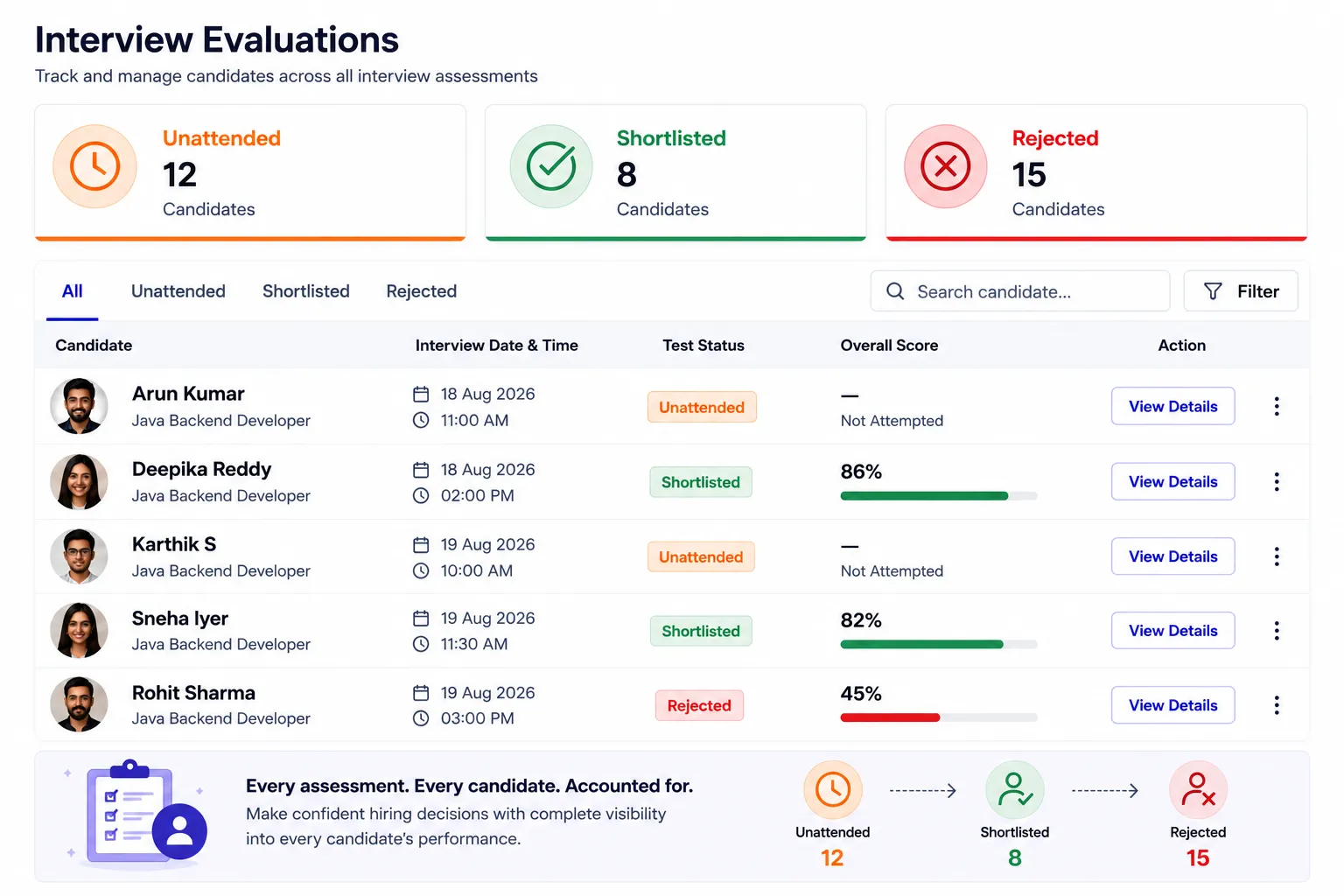
Interviews don't always go as scheduled, and Become A Skiller reflects that reality rather than hiding it. Candidates are automatically organized into categories that make the state of the hiring pipeline easy to read at a glance:
- Unattended — candidates scheduled for an interview who did not attend, kept separate for easy follow-up.
- Shortlisted — candidates selected after review of their full profile, VPE, and test results.
- Rejected — candidates who did not meet expectations, kept as a dedicated record for the hiring team.
For candidates who did complete the test, a full interview test preview is available — showing exactly how they performed, alongside their profile, VPE, projects, and certification. That combined view is what actually informs the final decision to select or reject, rather than the test score sitting in isolation.
Why This Same System Works Internally Too
What's easy to overlook is that none of this is limited to external hiring. Companies can run existing employees through the same courses, the same practical journey, and the same certification process to upskill their workforce — building internal talent pools, preparing staff for new responsibilities, and developing a certified, continuously improving team using the exact same infrastructure external candidates go through.
Seen this way, the interview test template, the AI-driven validation, and the candidate tracking aren't just recruitment tools — they're a evaluation system a company can lean on for both who it hires and who it grows.