
The job market in 2026 is more competitive and more technology-driven than ever — and the hardest part usually isn't finding job openings. It's everything around them: figuring out the right career path, closing skill gaps, gaining practical experience, proving capability, building an ATS-friendly resume, and standing out among candidates who are increasingly using AI to sharpen every part of their application.
Employers are facing a parallel version of the same problem. It's getting harder to tell candidates who merely claim a skill apart from candidates who can actually demonstrate it. What sits between the two sides is a real gap — between learning a skill and proving employability — and it's worth understanding exactly where that gap comes from before looking at how it can be closed.
Why the 2026 Job Market Feels Harder Than It Looks
A large share of candidate struggle doesn't come from a shortage of openings — it comes from uncertainty at almost every stage of the process. Many candidates simply don't know which career path fits their abilities, education, and goals, and that uncertainty is compounded by how quickly skill requirements themselves are changing, largely driven by AI. A skill that mattered two years ago may no longer be enough, while entirely new requirements keep appearing for roles that used to look stable.
This is where skill gaps become a genuine problem rather than a minor inconvenience. Job descriptions increasingly ask for capabilities candidates don't have, and the real challenge isn't trying to learn everything — it's identifying which skills actually matter. For freshers and career changers, this collides with a familiar catch: needing experience to get a job, but needing a job to get experience. A course completion certificate on its own rarely settles that problem, which is exactly why practical projects, internships, freelancing, and open-source work matter so much as evidence of real ability.
The Gap Between "I Learned It" and "I Can Prove It"
Even candidates who do have certificates often run into a second wall: convincing an employer they can actually perform the work. The question has quietly shifted from "Do you have a certificate?" to "Can you prove you can do the work?" — and that shift is happening at the same time AI tools make it easier than ever to produce a polished resume, a tailored cover letter, or a rehearsed interview answer.
That's not necessarily a bad thing for candidates — AI can genuinely help people prepare. But it creates a harder problem for everyone else: a good-looking application no longer reliably signals real capability, and over-reliance on AI can let a candidate produce an answer without actually understanding it. Automated recruitment systems add another layer to this — a qualified candidate can be filtered out simply because their resume doesn't clearly surface the right keywords, regardless of what they actually know how to do.
The practical effect is that demonstrated capability — something an AI can't fabricate on a candidate's behalf — is becoming the strongest form of differentiation available, especially for remote roles where an employer can't simply observe someone's past work firsthand.
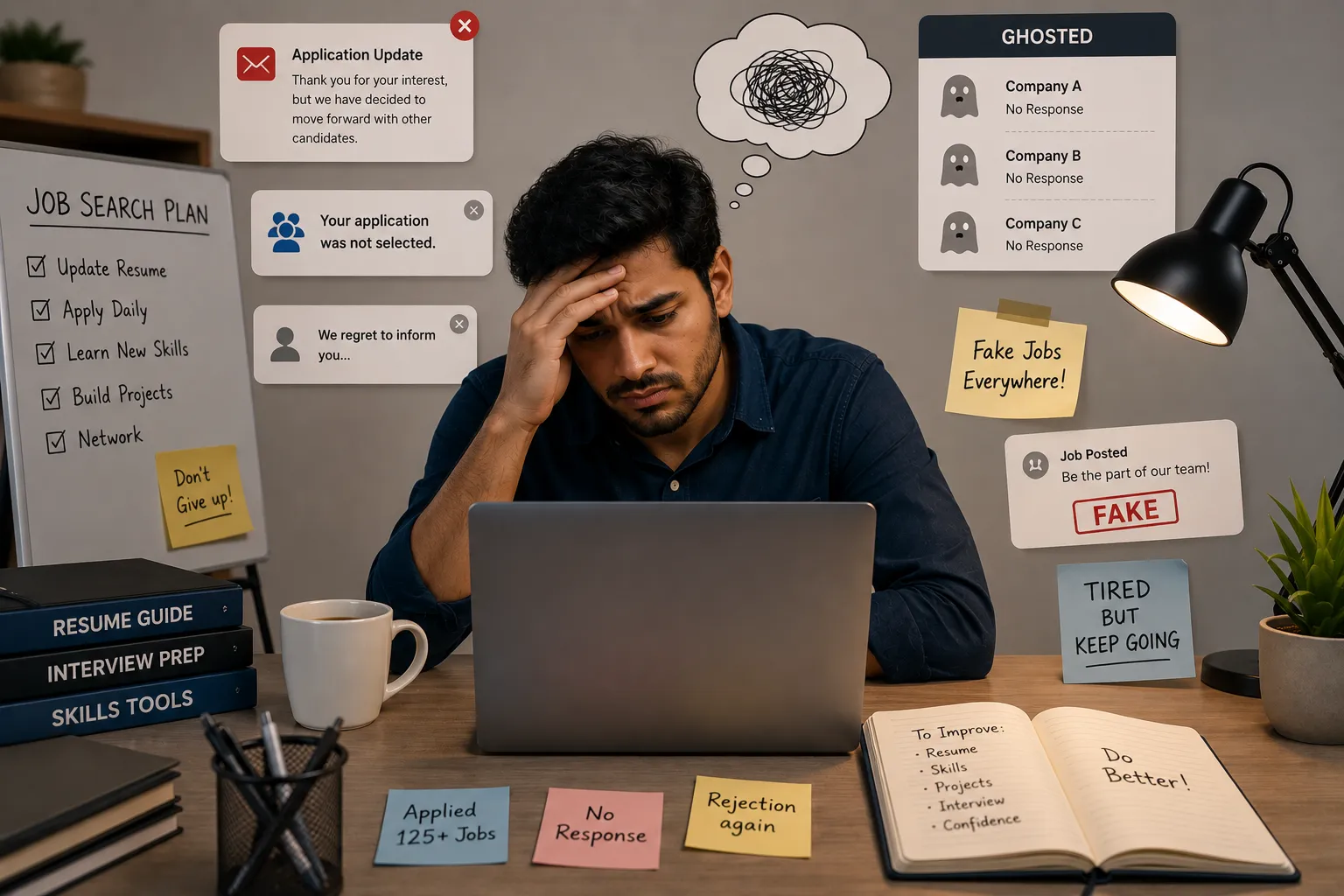
Where Confidence, Burnout, and Ghosting Come From
A lot of what makes job searching exhausting isn't any single obstacle — it's the cycle that forms when several of them combine. Rejection lowers confidence, lower confidence leads to weaker applications and interviews, and weaker performance leads to more rejection. Layered on top of that is the simple fatigue of applying to hundreds of generic listings without knowing which part of the process is actually failing: the resume, the skills, the targeting, or the application quality itself.
Company ghosting and fraudulent job postings make this worse, leaving candidates with no clear signal about what to improve or what to trust. The more useful response isn't applying to more jobs — it's applying to fewer, better-matched ones, and treating rejection as measurable, improvable feedback rather than a verdict on personal ability.
How Become A Skiller Closes This Gap
What makes this worth solving as one connected system, rather than a collection of separate features, is that every challenge above maps to a corresponding piece of evidence a candidate can build. Not knowing a career direction is addressed through role recommendations based on skills, interests, and goals. Changing skill requirements are addressed through ongoing role-to-skill mapping. Skill gaps themselves are addressed through AI-powered skill-gap analysis, rather than guesswork.
The deeper problem — lack of experience and lack of proof — is where the platform does its most important work: practical assignments and projects generate real experience, and that experience becomes Verified Practical Experience once it's backed by evidence. Certificates stop being a claim on their own and become evidence-backed credentials. Even the newer challenges around AI — polished but shallow resumes, AI-assisted competition, and AI-based interviews — are addressed the same way: through a proof-based candidate profile and hands-on practical validation that AI alone can't fabricate.
On the job-search side itself, relevant job matching and application funnel analytics help address the frustration of applying widely and hearing nothing back, while mock interviews and role-specific preparation help with the anxiety and unfamiliarity of technical and behavioral interview rounds. None of these are treated as isolated fixes — they're stages in a single, connected journey.
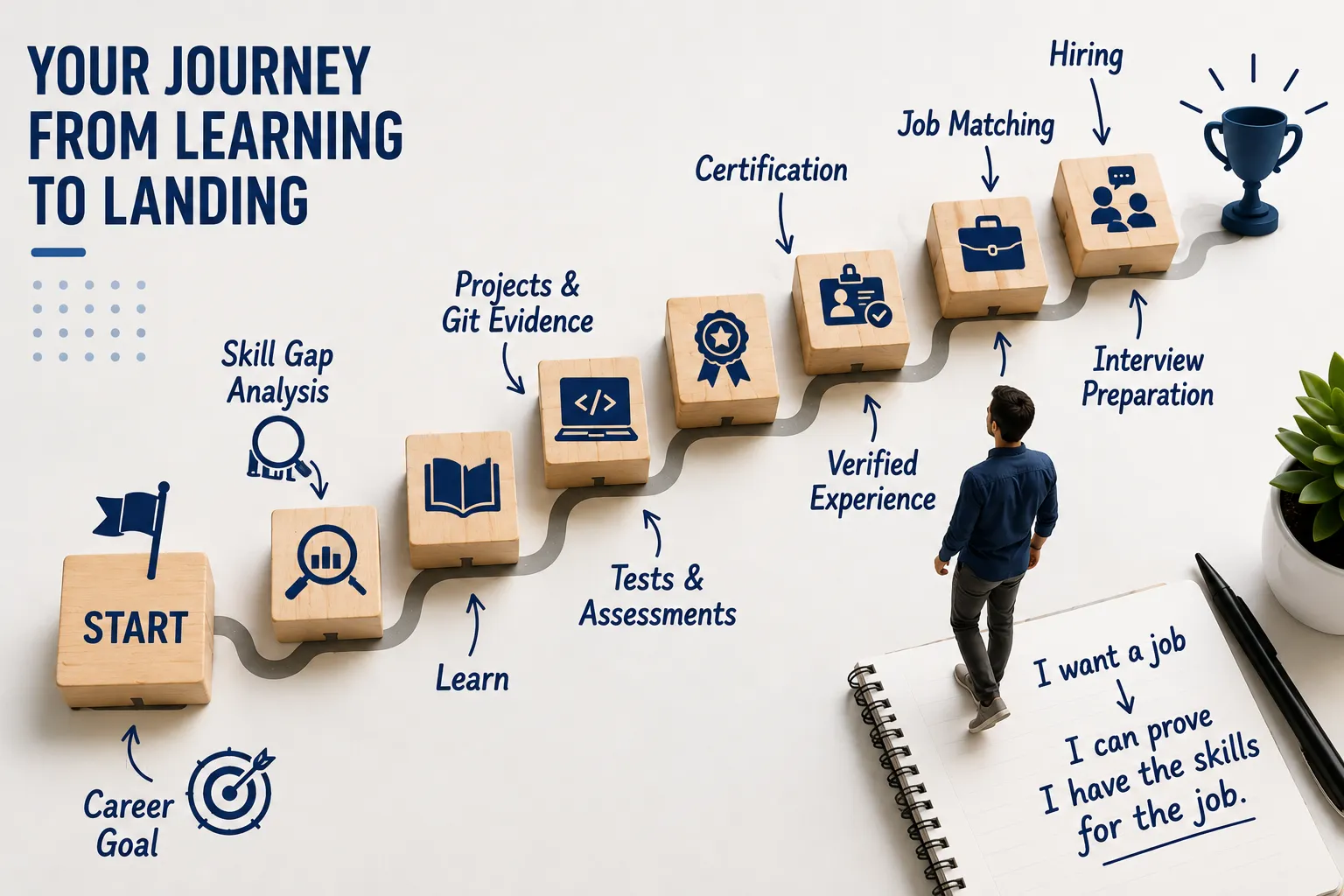
A Matching Problem With Two Sides
Ultimately, job searching is a matching problem between two sides. A candidate brings skills, experience, interests, education, location, salary expectations, and career goals. The job market brings open roles, required skills, salary bands, location, experience thresholds, and company requirements. Become A Skiller sits between these two sides — turning a candidate's journey from career goal, to skill-gap analysis, to learning, to practical training, to projects and Git evidence, to chapter tests, to a certification test, to AI validation and feedback, to certification, to Verified Practical Experience, to job matching, to interview preparation, to a company interview test, to AI evaluation, and finally to hiring.
Framed this way, the platform's role becomes clear: helping candidates move from "I want a job" to "I can prove I have the skills required for the job." And for companies, it means evaluating what a candidate has actually learned, practiced, demonstrated, and verified — instead of evaluating only what a resume claims.