Artificial Intelligence is changing the way software is developed, businesses operate, and people learn. But one transformation is receiving far less attention: the way knowledge itself is created, structured, validated and delivered is changing.
Traditionally, creating technical knowledge required subject matter experts, technical writers, instructional designers, developers and reviewers to work together. AI is now changing this workflow.
This is creating an emerging opportunity for a new kind of professional:
AI Content Engineer
An AI Content Engineer combines AI tools, software knowledge, research, analysis, content engineering and quality validation to transform complex knowledge into structured, useful and scalable digital assets.
This is not simply about asking an AI tool to write something. It is about knowing what to ask, how to structure the output, how to validate it, how to improve it and how to turn it into something reliable and useful.
Why Is AI Content Engineering Becoming Important?
The amount of technical knowledge being produced every day is growing rapidly. New programming frameworks, cloud platforms, AI models, APIs, development methodologies and business technologies appear continuously.
Organizations need to:
- Understand new technologies
- Document their systems
- Train employees
- Create technical documentation
- Build knowledge bases
- Develop learning programs
- Create assessments
- Maintain internal knowledge
- Convert expert knowledge into reusable assets
Doing all of this manually can be slow and expensive. AI can significantly accelerate these processes.
But AI-generated output cannot simply be accepted without review. AI can produce incorrect information, outdated information, incomplete explanations or technically invalid code.
This creates the need for professionals who can work between human expertise and AI systems. That is where AI Content Engineering becomes valuable.
What Does an AI Content Engineer Actually Do?
An AI Content Engineer designs and manages workflows that use AI to create, organize, validate and improve knowledge.
A typical workflow could look like:
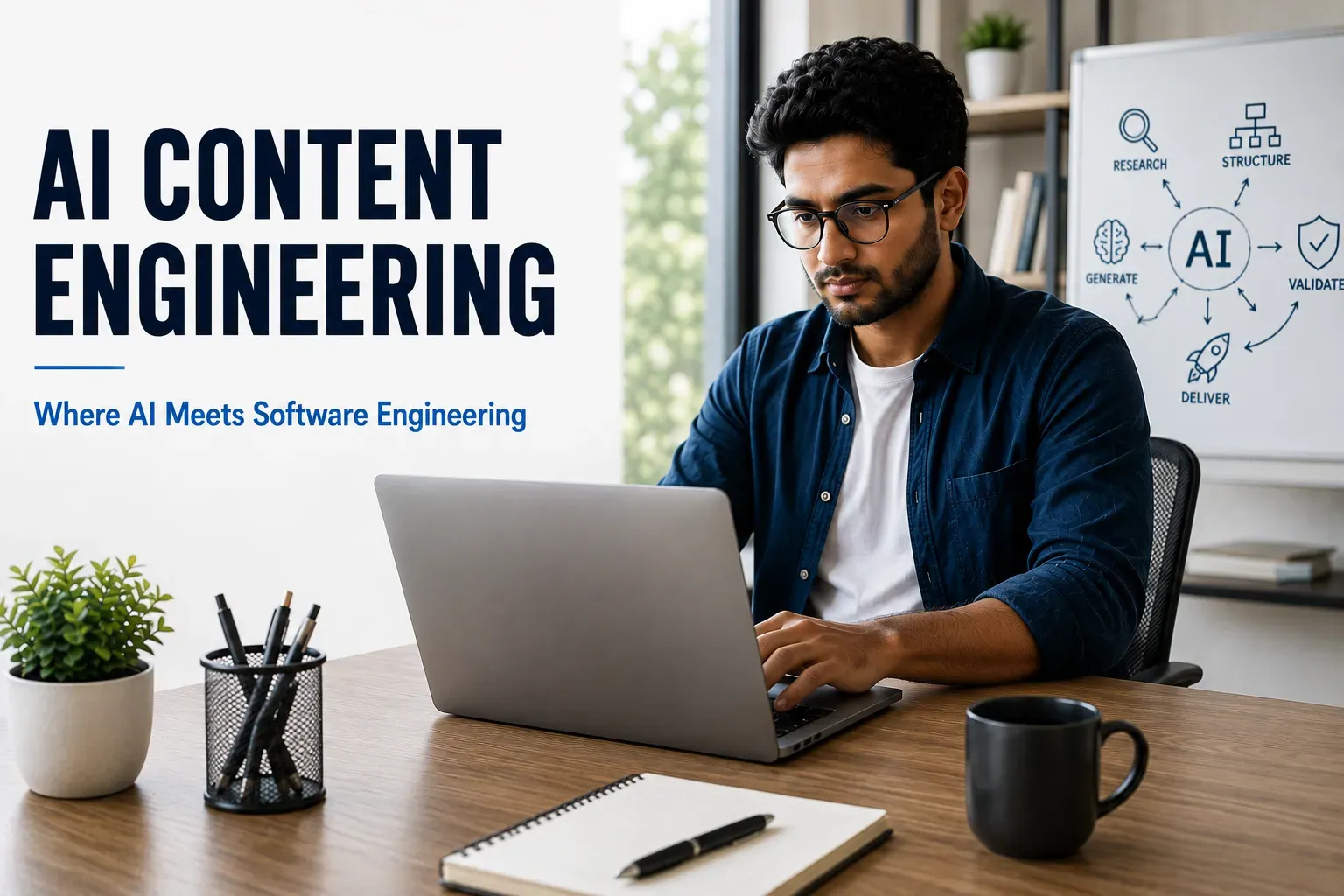
Research → Structure → Generate → Validate → Improve → Review → Publish → Maintain
For technical content, the process may involve:
- Researching a technology
- Creating a content structure
- Generating technical explanations
- Creating code examples
- Creating practical exercises
- Creating test scenarios
- Generating questions and assessments
- Validating technical accuracy
- Identifying AI hallucinations
- Reviewing outputs against trusted sources
- Maintaining versions
- Improving content based on feedback
The AI does much of the repetitive work. The engineer provides the process, judgment, validation and quality control.
AI Content Engineering Is Not Just Prompt Engineering
Prompt Engineering is one component of the skill. An AI Content Engineer needs a broader skill set.
AI Skills
- Generative AI
- Prompt Engineering
- AI-assisted research
- AI agents
- RAG and knowledge grounding
- AI workflow automation
Software Skills
- Programming fundamentals
- APIs
- Databases
- Git/GitHub
- Web and mobile concepts
- Software development lifecycle
Analytical Skills
- Requirement analysis
- Logical thinking
- Problem solving
- Information analysis
- Technical validation
Content Engineering Skills
- Knowledge structuring
- Documentation
- Technical explanations
- Practical exercises
- Assessment design
- Content quality assurance
Human Skills
- Communication
- Critical thinking
- Collaboration
- Domain understanding
- Ability to question AI output
The combination is what makes the role valuable.
Why Is This Relevant to Freshers?
For fresh graduates, entering the software industry can be challenging. Traditional entry-level roles often expect candidates to compete purely on programming knowledge. AI is changing that landscape.
A future software professional can increasingly be expected to know how to:
Understand → Analyze → Use AI → Validate → Improve → Deliver
A fresher who understands both software fundamentals and AI-assisted workflows can potentially contribute to several areas. For example:
- AI Business Analysis
- AI Software Development
- AI QA Engineering
- AI Technical Analysis
- AI Documentation
- AI Automation
- AI Knowledge Engineering
This means AI Content Engineering can become a foundation for a broader AI-enabled software career.
What About Experienced Professionals?
AI Content Engineering is not limited to freshers. Experienced developers, business analysts, testers, technical writers, trainers and domain specialists can use these skills to increase their productivity.
An experienced developer can use AI to accelerate:
- Code analysis
- Documentation
- Testing
- Refactoring
- Technical research
A Business Analyst can use AI to accelerate:
- Requirement analysis
- User stories
- Acceptance criteria
- Process documentation
- Gap analysis
A QA professional can use AI for:
- Test-case generation
- Test-data creation
- Edge-case discovery
- Defect analysis
- Automation support
The professional's experience remains important. AI becomes an amplifier of that experience.
The Future Career Model
The traditional model is:
Human → Work → Output
The emerging model is:
Human + AI → Engineered Workflow → Validated Output
The future professional will increasingly be expected not only to perform a task, but also to know how to use AI effectively to perform that task better.
This is why AI Content Engineering should be viewed as a broader capability rather than simply a content-creation job.
From AI Content Engineer to Multiple Career Paths
AI Content Engineering can act as a foundation for several career paths.
- AI Business Analyst — Use AI to analyze requirements, workflows and business processes.
- AI Software Developer — Use AI-assisted development while maintaining engineering standards.
- AI QA Engineer — Use AI to accelerate test design, validation and automation.
- AI Technical Analyst — Analyze systems, APIs, databases and technical dependencies.
- AI Knowledge Engineer — Build structured knowledge systems and AI-powered knowledge workflows.
- AI Learning Architect — Design large-scale AI-powered learning and knowledge ecosystems.
This creates an evolving career rather than a narrowly defined job.
What Makes the Skill Future-Oriented?
AI tools will continue to change. Today's AI tools may not be the same tools professionals use five years from now.
Therefore, the most important skill is not memorizing a particular AI tool. It is learning how to:
Understand AI → Design workflows → Validate outputs → Integrate AI → Continuously improve
That capability can remain valuable even as individual AI tools evolve.
Learning by Building
The strongest way to learn AI Content Engineering is not by learning prompts alone. It is by building real workflows.
A learner should be able to take a subject and create a complete AI-assisted workflow:
Knowledge → Research → Structure → Generate → Validate → Test → Improve
The final outcome should demonstrate practical capability rather than simply knowledge of AI terminology.
A New Generation of Software Professionals
The software industry is moving toward a world where AI becomes part of everyday professional work.
The question is no longer:
"Will AI replace software professionals?"
A more useful question is:
"Which professionals will know how to work effectively with AI?"
The next generation of professionals will combine:
Domain Knowledge + Software Skills + AI + Critical Thinking + Validation
AI Content Engineering sits at that intersection. For freshers, it can provide a new entry point into the technology industry. For experienced professionals, it can provide a way to amplify existing expertise. And as AI continues to evolve, the role itself will continue to evolve with it.
The future may not belong to people who simply know AI. It may belong to people who know how to engineer work around AI.