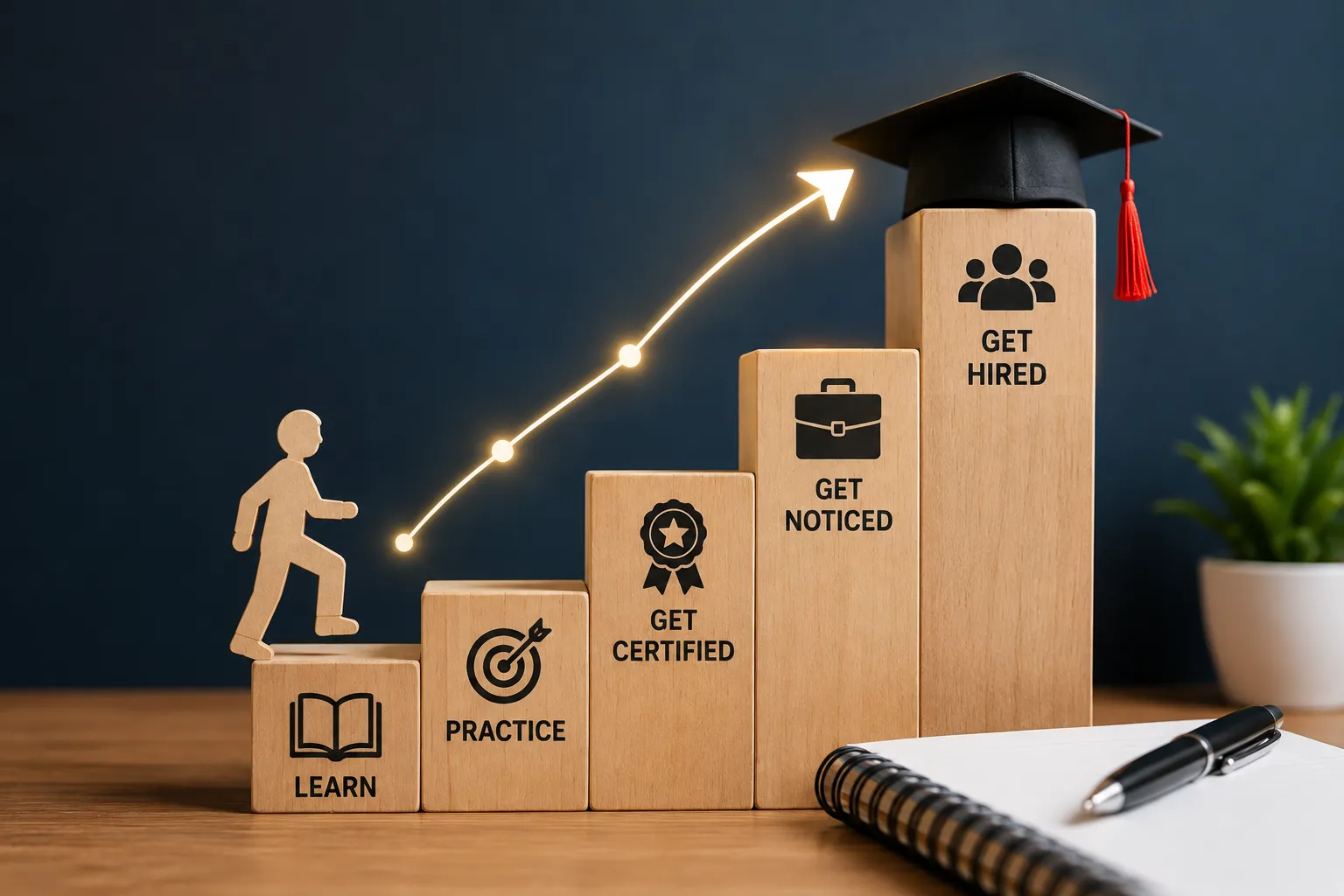
Starting a new skill can feel overwhelming. Which course should you pick? Will you actually stick with it? How do you know if you're improving? And once you're done, how do you prove what you've learned to someone who's hiring?
Become A Skiller was built to answer all of these questions in one place. Whether you're a college student trying to break into tech, a working professional picking up DevOps or cloud skills, or someone learning spoken English or electrical fundamentals for a completely different career path, Become A Skiller gives you a structured, supported, and measurable way to learn — and, eventually, a way to turn that learning into a real job opportunity.
Here's exactly what you'll find on the platform and what your journey looks like from your first course to getting noticed by companies.
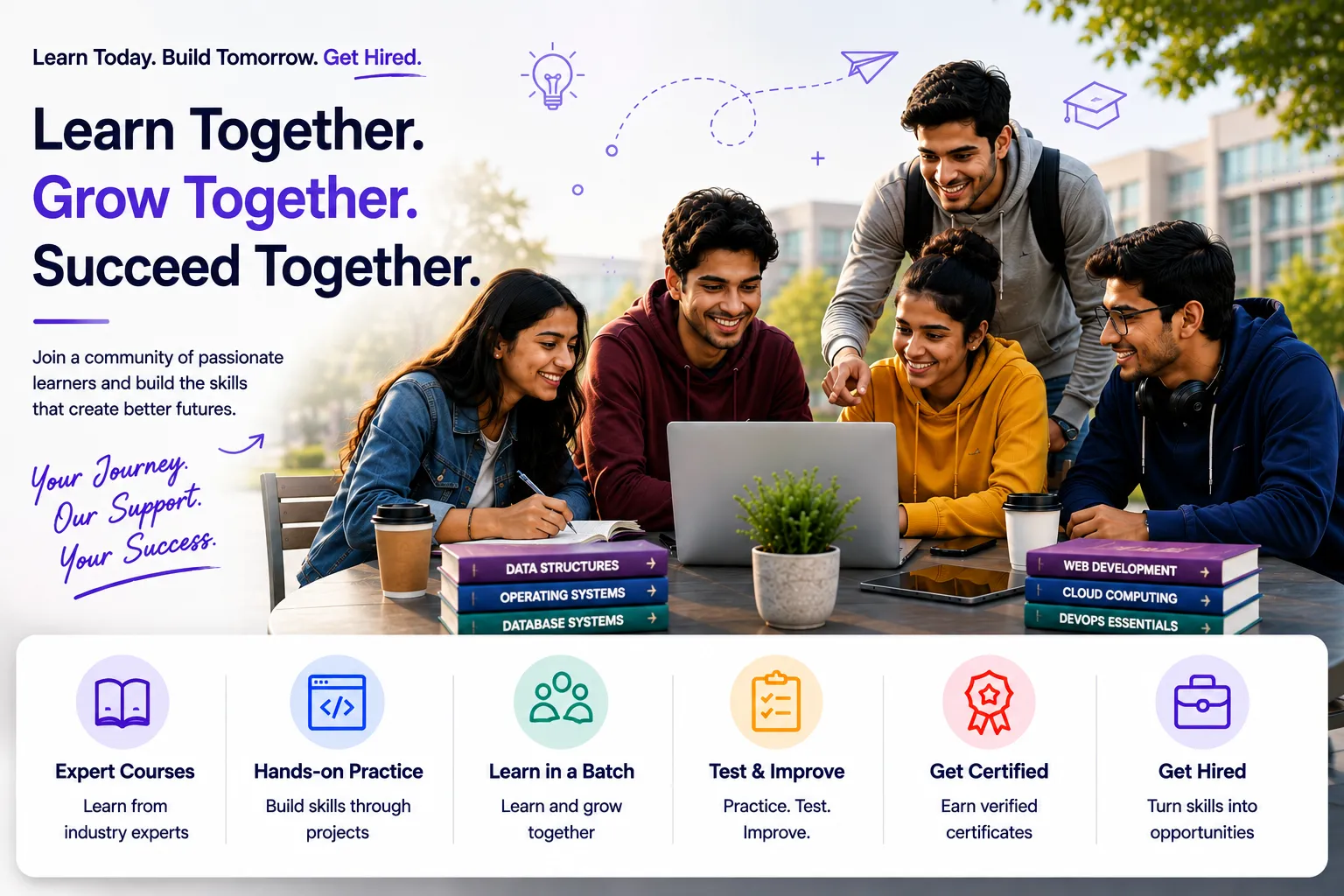
A Course Library Built for Real Career Paths
Become A Skiller isn't just IT-focused, and it isn't just a random assortment of courses either. You'll find two broad categories:
- Technology courses — Frontend Development, Backend Development, DevOps, Azure Cloud, React, Angular, and more, covering the skills companies are actively hiring for.
- Non-IT courses — including EEE (Electrical and Electronics Engineering) fundamentals and Spoken English, for learners building skills outside the software world.
Every course is designed around one goal: getting you from "I want to learn this" to "I can actually do this," not just "I watched a video about this." You start by browsing the course explore page, reading what each course actually covers, and subscribing to the one that matches where you want to go — not just what sounds interesting today.
Learn at Your Own Pace, With Structure Built In
Once you subscribe to a course, you're not left to figure things out on your own. Courses are broken into modules and chapters, so your learning has a clear shape and direction — you always know what's next and how far you've come.
Because it's self-paced, you're not boxed into rigid class timings. Learn early in the morning, late at night, or in short bursts between other commitments — the course structure stays consistent, but your schedule doesn't have to. Along the way, self-paced tests check that concepts are actually landing before you move on to the next chapter.
Learn Alongside a Batch — You're Never Doing This Alone
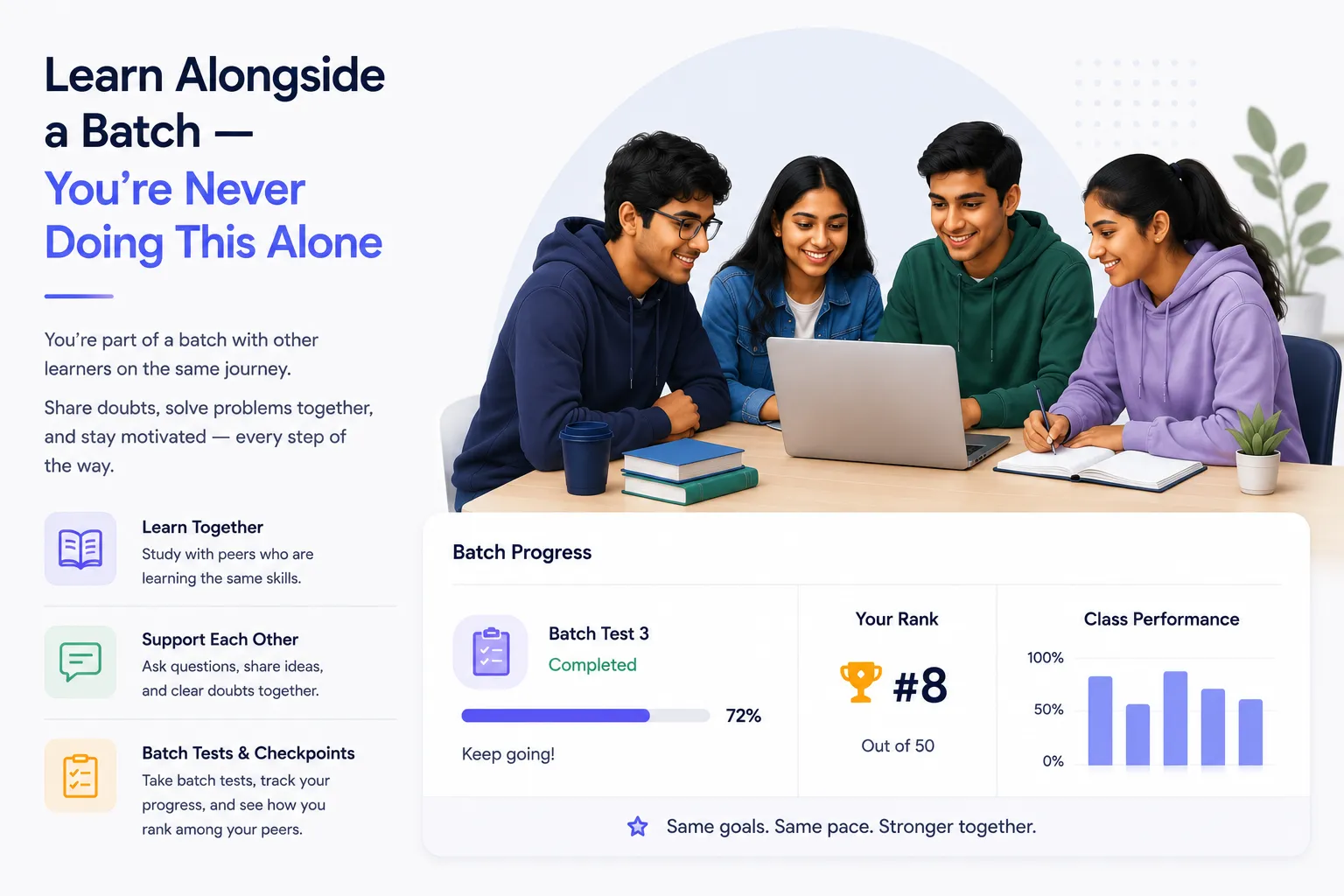
One of the things that makes Become A Skiller different from a typical self-paced course is the batch system. When you subscribe to a course, you're placed in a batch with other students learning the same thing around the same time.
This matters more than it might sound like at first. Learning alone is one of the biggest reasons people give up halfway. Being part of a batch means you have peers hitting the same challenges you are, at roughly the same time, a shared sense of pace and momentum, and a community around what would otherwise be a solo effort.
Your batch isn't just a background detail either — it's where batch tests happen, checkpoints that assess how your whole group is doing at a given stage, giving you a sense of where you stand alongside the people learning right next to you.
Quizzes and Practical Exercises That Actually Test Understanding
At the end of each module or chapter, you won't just move on automatically. You'll face quizzes that test your conceptual understanding, and practical exercises that test whether you can actually apply what you learned.
This is especially important for IT courses. Reading about React components is very different from building one. That's why practical exercises are central to how Become A Skiller works, not an optional add-on. Every quiz and exercise is a real checkpoint — if a particular exercise feels difficult, that's useful information pointing you back to the module worth revisiting, not a sign to push through and move on regardless.
Submit Your Work Through GitHub — And Get Evaluated by AI
Here's where Become A Skiller goes a step further than most e-learning platforms. For practical exercises, you'll submit your work directly through GitHub, just like you would in a real development environment. This alone builds a habit that matters enormously in the tech industry: version control, clean commits, and a growing portfolio of real work.
Once submitted, your work is evaluated by AI, which reviews your code and gives you feedback — not just a pass/fail, but insight into how well you've applied what you learned. Getting comfortable with GitHub early pays off well beyond the course itself, and the feedback from each evaluation is one of the fastest ways to close gaps before they compound.
Track Your Progress and Get Real Insights
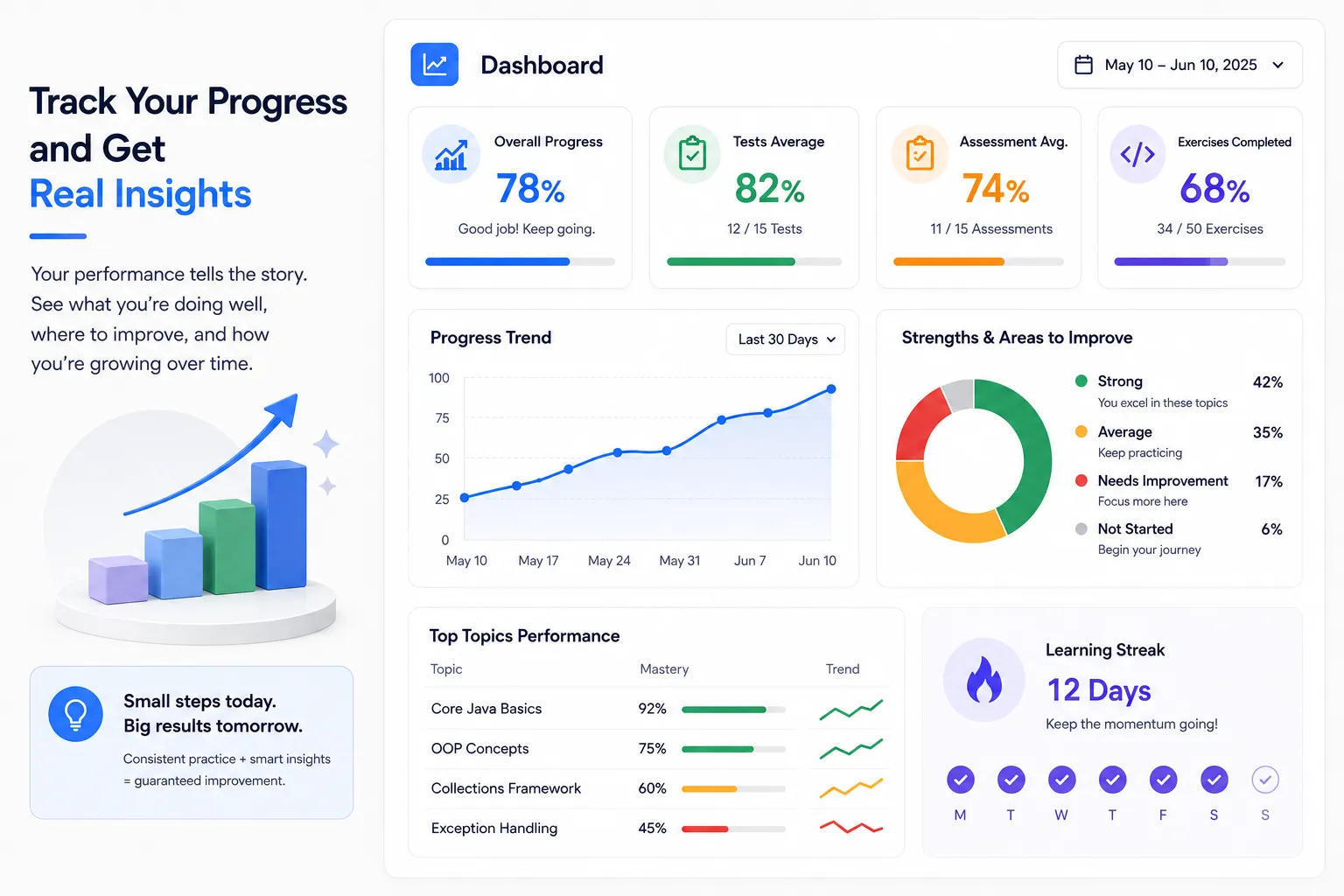
Learning without visibility into your own progress makes it hard to stay motivated or know where to focus. Become A Skiller solves this with a progress and insights dashboard built from your actual performance — your test scores, assessment results, and exercise evaluations feed directly into it.
Instead of vague encouragement, you get specific, data-backed insight into which topics you're strong in, which ones need more attention, and how you're trending over time. Checking in on this regularly, rather than only at the end of a course, is what turns a dashboard into an actual learning tool.
The Certification Test: Proving What You Know
Once you've completed all the content in a course, there's one more milestone: the assessment test, also known as the certification test. This isn't just another quiz — it's assigned directly by your trainer, and it's designed to validate two things at once: that you've genuinely covered the content, and that you can complete tasks on your own, using your own knowledge, without leaning on the material in front of you.
Your trainer reviews your performance on this test and personally verifies your knowledge before issuing your certificate. This human verification is what makes the certificate mean something — it isn't an automatic badge for finishing videos, it's a trainer's confirmation that you genuinely know what the course set out to teach you.
Once your certificate is issued, you become a certified student on Become A Skiller — a status that carries real weight everywhere else on the platform.
Companies Are Watching — And Certified Profiles Get Seen
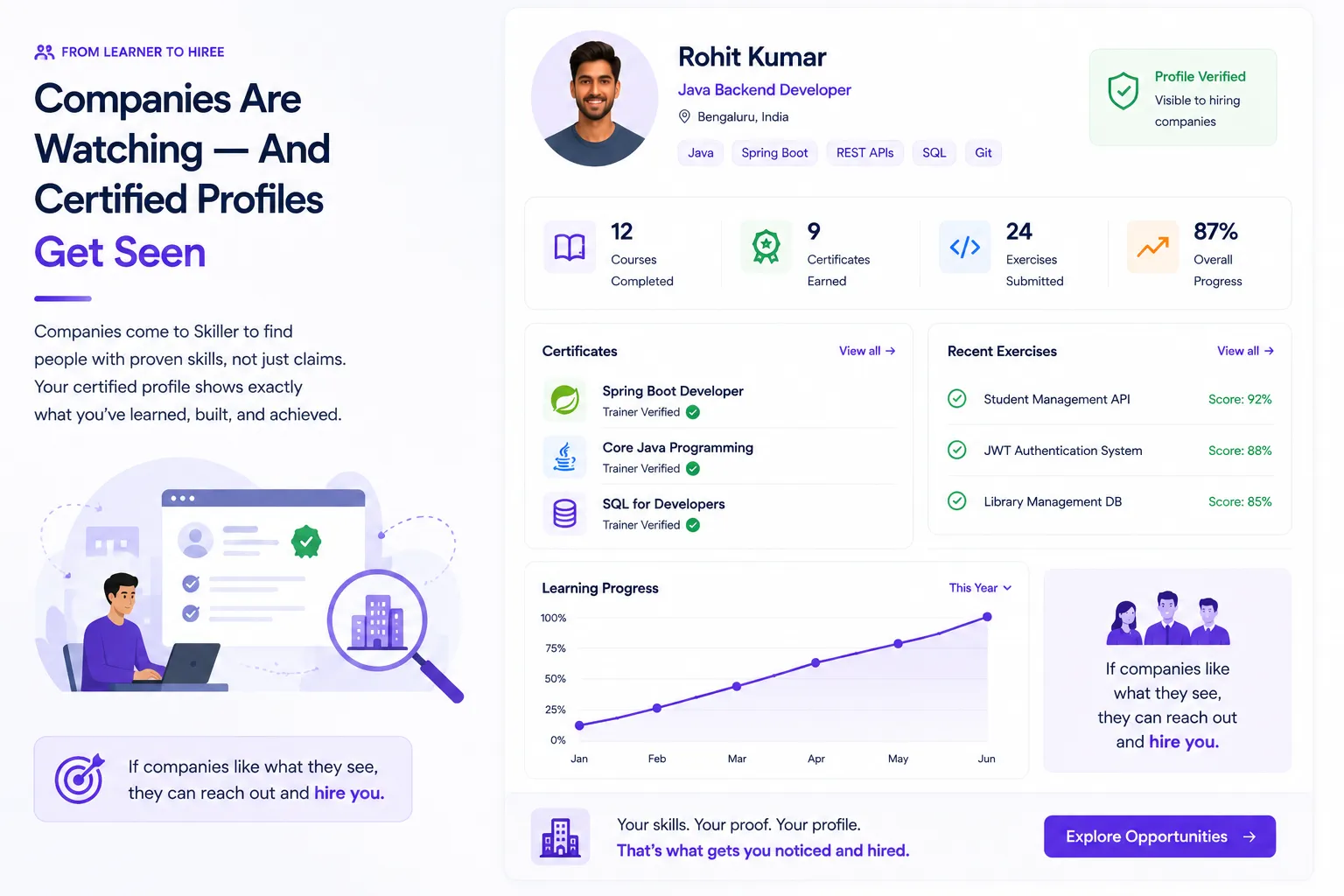
This is where all the work comes full circle. Companies come to Become A Skiller too — not to browse courses, but to fill their own hiring needs. When they do, they look specifically at certified profiles, browsing through students and job seekers who've proven their skills rather than just claimed them.
A company reviewing your profile sees exactly what you've built: the courses you've completed, the trainer-verified certificates you hold, the practical exercises you've submitted and how they were evaluated, and the overall trajectory shown in your progress insights. If they like what they see, they can reach out and hire directly from your profile.
This changes what "learning" means on Become A Skiller. Every module you finish, every exercise you submit, every test you pass isn't just a step toward personal growth — it's a brick in a profile you're actively building for the people who'll eventually be deciding whether to hire you. The stronger and more complete that profile becomes, the more it can genuinely speak for you in front of a recruiter, without you needing to be in the room.
Putting It All Together: A Student's Journey on Become A Skiller
The path looks like this: you explore the course library and choose one aligned with your goals, subscribe and get placed into a batch with fellow learners, and move through the content module by module at your own pace. Along the way, self-paced tests and batch tests check your understanding, while quizzes and hands-on exercises after each module push you to actually apply what you've learned — with practical work submitted via GitHub and evaluated by AI.
Once you've finished the content, your trainer assigns your certification assessment. Passing it — and having your trainer verify your knowledge — makes you a certified student, with a certificate that shows up as part of your profile. From there, your progress and insights dashboard, your batch events, and your growing body of evaluated work all combine into a profile that companies can actually see and act on when they're hiring.
Why This Matters for You
The biggest difference between Become A Skiller and simply watching free tutorials online is accountability and proof. It's easy to watch a video and feel like you've learned something. It's much harder — and much more valuable — to prove you can actually do it, and to have that proof land directly in front of the companies deciding who to hire. Become A Skiller is built around that gap: structured courses, real practical evaluation, trainer-verified certification, and a profile that stands in for you when you're not in the room.
Wherever you're starting from, every course you finish and every skill you prove brings you a step closer to a profile that speaks for itself. Explore the course library and take that next step, at your own pace.